How to choose a 3D printing filament
A home 3D printer is usually choosing between PLA, PETG, ABS, ASA and TPU. They differ in temperature, warping, and whether the part must be stiff, flexible or used outdoors.
A print starts with the material. The same file in a different filament comes out with different strength, different heat behaviour and a different grip on the bed. At home the choice is not between two boxes. It is between the conditions: a part on a shelf, a part that carries weight, a part that lives outdoors, or a part that has to flex.
Five filaments cover that for a home 3D printer: PLA, PETG, ABS, ASA and TPU. The numbers below are the usual ranges. A specific box can state a narrower window, and then the box wins.
What to check first
A part on a shelf and a part that carries weight by a window are not under the same conditions. Four things matter: nozzle temperature, bed temperature, whether a chamber is required, and whether the plastic absorbs moisture.
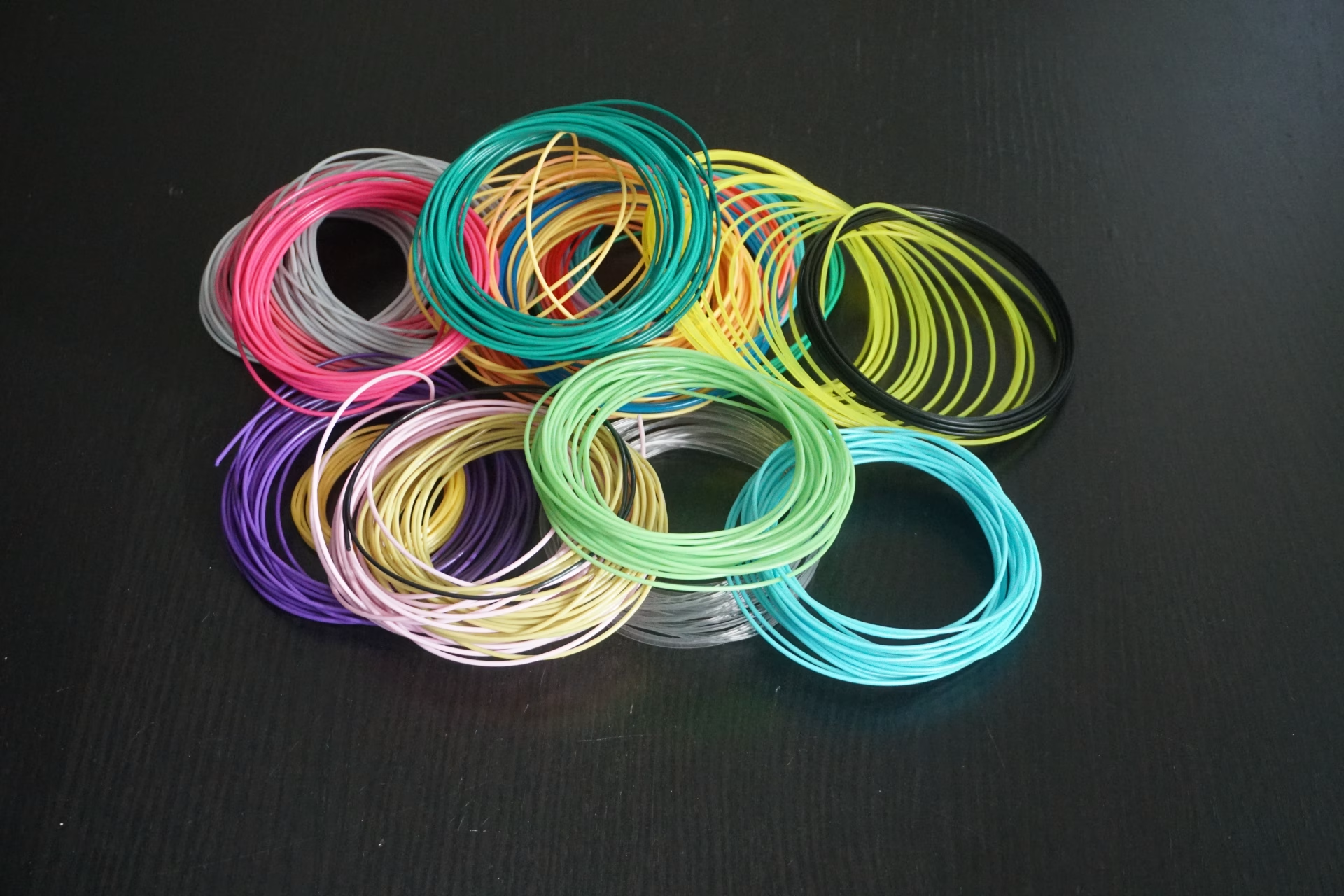
A home 3D printer usually needs 1.75 mm filament. That diameter fits almost every machine from the last few years. 2.85 mm belongs to older printers and will not feed a 1.75 mm extruder. A spool is usually 1 kg. Colour does not change the mechanics. It only makes the layers easier or harder to see.
| Filament | Nozzle | Bed | Chamber | Fits |
|---|---|---|---|---|
| PLA | 190–220 °C | 0–60 °C | No | Models, indoors |
| PETG | 230–250 °C | 70–80 °C | Optional | Brackets, boxes |
| ABS | 230–250 °C | 90–110 °C | Yes | Tough indoor parts |
| ASA | 240–260 °C | 90–110 °C | Yes | Outdoor parts |
| TPU | 210–240 °C | 30–60 °C | No | Flexible parts |
PLA
PLA, polylactic acid, is the easiest home filament. It melts at a lower temperature and sticks to the bed, so the first layer often works without a long tuning session. The nozzle is usually 190–220 °C. A heated bed is not required, but 50–60 °C keeps the corners down. Warping is low and there is little smell, so a living room is fine.
Heat is the weak point. PLA starts to soften around 55–60 °C. A summer car, a sunny windowsill or a radiator is enough to lose the shape. An impact snaps it more often than it bends. PLA fits figures, scale models, indoor objects and test prints that stay at room temperature.
PETG
PETG is glycol-modified polyethylene terephthalate. It is harder to print than PLA and easier than ABS, and it holds up better than PLA where the part has to flex a little. The nozzle is usually 230–250 °C, some blends to 260 °C. The bed is 70–80 °C. A chamber is not required, but a draught can still lift corners.
PETG is sticky, so a first layer that is too close can tear the bed coating when the part comes off. It leaves thin strings between walls when retraction is low. It absorbs moisture: opened filament crackles during a print and the surface comes out pitted. Dry it at about 65 °C before a long job and keep it in a sealed bag. PETG fits brackets, covers and parts that sit warmer than a room, but not in permanent sun.
PLA and PETG are compared more closely in PLA and PETG.
ABS
ABS is a technical filament for indoor parts that have to take impact and heat. Tool handles, housings, mechanical pieces. It keeps its shape up to about 100 °C, so it is still rigid where PLA has already softened.
The nozzle is 230–250 °C, the bed 90–110 °C. An enclosed chamber is required. Without it a larger part warps, the corners lift off the bed and the layers split. The smell is sharp, so the room needs ventilation. Keep the fan low or the layers never bond. ABS is a bad first filament. Until the first layer is stable in PLA, ABS only shows every problem in the 3D printer at once.
ASA
ASA prints much like ABS and lives outdoors differently. It resists ultraviolet light and weather, so the colour does not yellow as fast in the sun. ABS outdoors loses both colour and strength over a season. ASA is for outdoor brackets, signs and housings that get rained on and heated.
The nozzle is usually 240–260 °C, the bed 90–110 °C, and a chamber is required just as with ABS. The name ASA does not remove warping. The smell is milder, but the room is still ventilated. If the part stays indoors, ASA is unnecessary. If it lives outside, ABS is the weaker choice.
TPU
TPU is the flexible filament. Gaskets, protective cases, straps, anti-vibration feet. Hardness is given as Shore. 95A is still stiff enough to feed. 85A is softer and fussier.
The nozzle is 210–240 °C, the bed 30–60 °C. No chamber. Speed stays low, often 20–40 mm/s, because a soft strand buckles in the extruder and jams. A 3D printer with a direct extruder runs TPU more calmly than one that pushes the filament through a long tube. The first try should be the harder TPU, not the softest.
How to decide
Decoration and the first calibration of a 3D printer are PLA. A functional part that must flex and sit warmer than a room is PETG. A tough indoor part that needs impact and heat resistance is ABS, if the printer has a chamber. An outdoor part takes ASA instead of ABS. A flexible part takes TPU.
On a new 3D printer the start is still PLA. The lower temperature and lower warp show sooner whether the printer needs calibration, or the plastic does. Three lines on the box are worth reading: 1.75 mm, the nozzle range, and whether the bag is still sealed.
PLA is in the PLA section, PETG in the PETG section.